Who Can Endorse a Business Check?
Not everyone can endorse a business check. A qualified person might be the business owner, treasurer, secretary, or business accountant, but the business has to assign the authority to a specific person or persons.
Although some banks will accept a check with no endorsement, there might be a dollar amount limit to this service. The bank may also decide to hold the funds for longer than normal if the business check has no endorsement. The person who signs the business check is authorizing the bank to cash the check in their name, they just need to write out their own title.
So, what is the correct way to endorse a business check? To endorse a check, you simply turn it over and sign your name on the back. Most checks give you a space on the back for your endorsement. You'll see a few blank lines and an "x" that indicates where you should sign your name.
Visit Checkomatic.com to shop Business Checks, Computer Checks, or Manual Checks.
How Businesses Assign Check Endorsement Authority
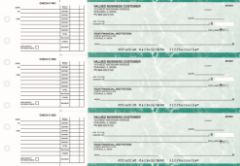
Checkomatic AP business checks , the back of every check carries the standard endorsement area where your authorized signer adds their name and title.
As the original content correctly identifies, the business must assign the authority to endorse checks to specific people. This is not just a practical matter , it is a banking requirement. Most banks require businesses to designate authorized signers when opening a business checking account, and those designations are documented on the bank's account signature card or corporate resolution form.
How Authorization Is Typically Documented
Businesses formalize endorsement authority in several ways depending on their size and structure:
- Bank signature card: At account opening, the bank collects signatures from all individuals authorized to sign on the account. This includes both check-writing authority and endorsement authority for depositing checks received.
- Corporate resolution: For corporations, LLCs, and partnerships, a formal corporate resolution signed by the board or members specifies which officers have authority over the business bank account. This document is filed with the bank and updated whenever authority changes.
- Internal authorization policy: Sole proprietors and small businesses often document authorization informally in internal policies, though the bank's signature card remains the controlling document from the bank's perspective.
When Authority Changes
If a treasurer, bookkeeper, or authorized signer leaves the business or changes roles, the bank authorization must be updated. An outdated signature card that still includes a former employee creates both an administrative risk and a potential fraud exposure. Contact your bank to remove or add authorized signers whenever your business's personnel or structure changes.
The Three Types of Business Check Endorsements
As the original content correctly identifies, the correct way to endorse a business check is to sign the back of the check in the designated endorsement area. However, there are three distinct endorsement types, and the one you use determines how the check can be processed after endorsement.
| Endorsement Type | What It Looks Like | What It Does |
|---|---|---|
| Blank endorsement | Signature only, no additional words | Makes the check payable to anyone who holds it , the least secure option |
| Restrictive endorsement | "For deposit only" + account number + signature | Limits the check to deposit in the named account only , cannot be cashed or transferred |
| Special endorsement | "Pay to the order of [name]" + signature | Transfers the check to a specific third party , rarely used in standard business AP operations |
Blank Endorsement on a Business Check
A blank endorsement is the simplest form: the authorized signer writes their name and business title on the back of the check, with no additional notation. This makes the check negotiable by anyone who holds it. For business checks, a blank endorsement creates unnecessary exposure if the check is lost or intercepted after endorsement. It should only be used immediately before handing the check to a teller at the bank counter.
Restrictive Endorsement (For Deposit Only)
A restrictive endorsement adds the words "For deposit only" above or below the signature, along with the business bank account number. This limits what the bank can do with the check: it can only be deposited into the specified account. It cannot be cashed, handed back to the payee, or transferred to a third party. Restrictive endorsements are the recommended standard for business check deposits, particularly when checks are mailed to the bank, processed in batches, or handled by multiple employees before deposit.
Special Endorsement (Third-Party Transfer)
A special endorsement transfers the check to a third party by writing "Pay to the order of [third party name]" above the signature. The check then becomes payable to that named third party. Special endorsements are uncommon in standard business AP and AR operations and are generally not recommended for routine use because they create a longer transaction chain and additional verification requirements at the bank.
What Happens When a Business Check Has No Endorsement
As the original content correctly identifies, some banks will accept a check with no endorsement, but there may be a dollar amount limit on this accommodation. The bank may also decide to hold the funds for a longer period than normal when a check is deposited without endorsement.
Under UCC Article 3, which governs negotiable instruments in the US, a check technically requires endorsement to be negotiated. However, many banks have internal policies that allow deposit of unendorsed checks under certain conditions, typically for well-established accounts with a history of regular deposits. The specific policy differs by institution and account type.
Practical Risks of Depositing Without Endorsement
- Extended hold times: The bank may apply a longer funds availability hold to an unendorsed check, delaying access to the deposited amount.
- Dollar amount limits: As the original content correctly identifies, there may be a dollar limit above which the bank will not accept an unendorsed check.
- Return risk: The bank may return the check unpaid if its processing system flags the missing endorsement, requiring you to re-deposit with a proper endorsement.
- Audit and record issues: An unendorsed check creates a less clean paper trail for your business's financial records and reconciliation process.
For complete guidance on check management and reconciliation, see checkbook management: how to balance and reconcile.
How Endorsement Connects to Check Fraud Protection
Checkomatic business check security features , quality check stock and proper restrictive endorsement practice work together to protect your business against check fraud.
Endorsement is one of the key control points in business check fraud. A check that is endorsed with only a signature (blank endorsement) can be deposited by anyone who obtains it after endorsement. A check that is endorsed restrictively ("For deposit only" with the account number) can only be deposited into the named account, regardless of who physically holds it.
Check Washing and Endorsement Risk
Check washing is a form of check fraud in which a criminal uses solvents to remove the ink from a check and rewrites the payee name and amount. A check that has already been restrictively endorsed is harder to fraudulently redirect because the endorsement restricts its use to a specific account, even if the face of the check is altered. Quality check paper from Checkomatic includes chemical-reactive paper that stains visibly when washing solvents are applied, helping to reveal tampering before the check reaches the bank. For the complete guide to check fraud and protection strategies, see what is check washing and how to protect your business and are business checks safe: security features that actually matter.
Internal Controls on Endorsement Authority
Limiting endorsement authority to specific named individuals is itself a fraud control. When only the business owner, treasurer, or accountant can endorse incoming checks, it reduces the opportunity for unauthorized employees to divert payments. Combined with restrictive endorsements and quality check stock, formal endorsement authorization is part of a layered approach to business check security.
Endorsement Stamps for High-Volume Business Check Deposits
For businesses that regularly receive and deposit multiple checks , such as those processing customer payments, vendor rebates, or insurance reimbursements , hand-writing the endorsement on every check is time-consuming and introduces inconsistency. An endorsement stamp solves this by applying a pre-set restrictive endorsement to each check in one impression.
What a Business Endorsement Stamp Contains
A standard business endorsement stamp typically contains the words "For deposit only," the business name, and the bank account number. Some stamps also include the bank's routing number. Every check receives the same consistent endorsement with a single impression, eliminating the need for handwriting and ensuring that every deposited check is restrictively endorsed.
When an Endorsement Stamp Makes Sense
- Your business regularly processes five or more incoming checks per week
- Multiple employees handle check receipt and sorting before a designated person deposits them
- You want to ensure every check is restrictively endorsed at the point of receipt, not just at the moment of deposit
- Your accounts receivable workflow involves batching checks before a periodic deposit run
What Customers Say About Checkomatic
All reviews below are published on checkomatic.com and reproduced verbatim. Source: checkomatic.com/quickbooks-starter-pack-product, 4.5 stars from 166 verified reviews.
"Been with them for 15 years. Always reliable, always good quality, good service. What more can you ask for?"
ATV Inc. | ★★★★★ 5/5 | April 5, 2024 | Source: checkomatic.com/quickbooks-starter-pack-product
"First time ordering and I am super impressed with the quality of the checks. No issues with delivery. I will be ordering again!"
TClinton | ★★★★★ 5/5 | April 9, 2025 | Source: checkomatic.com/quickbooks-starter-pack-product
"We use CheckoMatic for all of our check needs! They have great prices and we receive our products in a timely manner!"
CG's Tax Service | ★★★★★ 5/5 | September 18, 2024 | Source: checkomatic.com/quickbooks-starter-pack-product
"I got 500 checks for less than half of what the bank wanted for 200!"
VVA Voucher Checks (Vietnam Veterans of America) | ★★★★★ 5/5 | July 6, 2024 | Source: checkomatic.com/quickbooks-starter-pack-product
"ASJ Wilson Construction has been a client of checkomatic for some years now and they've never disappointed this company. Thank you checkomatic for all that you do."
ASJ Wilson Construction | ★★★★★ 5/5 | June 6, 2024 | Source: checkomatic.com/quickbooks-starter-pack-product
"Affordable and efficient. My go-to business check printer."
Doe | ★★★★★ 5/5 | January 24, 2025 | Source: checkomatic.com/quickbooks-starter-pack-product
Why Choose Checkomatic for Business Checks
Checks Designed for Proper Endorsement Workflows
As the original content correctly identifies, the person signing a business check is authorizing the bank to process it. Checkomatic's business checks include the standard endorsement area on the back of every check, formatted to ABA standards. The endorsement space is correctly positioned and sized for both handwritten endorsements and endorsement stamp use. Browse the full range at business checks, computer checks, and manual checks.
Security Features That Complement Endorsement Controls
Proper endorsement is one layer of business check security. Quality check stock is another. Checkomatic's business checks include chemical-reactive paper, microprinting, void pantograph, heat-sensitive ink, true watermark, and coin-reactive ink on every order as standard. These features work alongside proper endorsement practices to protect your business payments from fraud. For the full security feature guide, see are business checks safe: security features that actually matter.
MICR Encoding for Reliable Processing
Every Checkomatic business check is printed with ANSI E13-B certified MICR encoding on the MICR line, which ensures reliable automated processing at all US banks. A properly endorsed check on quality MICR-encoded stock processes through the bank's clearing system cleanly, without holds or manual routing delays. For the complete MICR line guide, see MICR line explained: the technology behind every check.